
Change is afoot in the Falkland Islands
A decisive and orderly election has shown that in the Falklands, self-determination is not a slogan rooted in 2013, but a living democratic practice.
NEWS FROM THE OVERSEAS TERRITORIESFALKLAND ISLANDSOPINION
Few places demonstrated the quiet strength of democracy quite like the Falkland Islands. Small in population, remote in geography, and often viewed internally only through the prism of sovereignty disputes, the Falklands nonetheless operates a political system that would be recognisable and admirable in any mature democracy. Elections are free and fair, candidates stand as individuals rather than party labels, the media scrutinises those in office, and the result is accepted without question. Independent observers are unnecessary, although utilised for the first time, because confidence in the system is so high.
That matters, as for decades, Falkland Islanders have made clear that the future is theirs alone to decide. From the 2013 referendum to successive general elections, the Islands have consistently demonstrated that self-determination is a lived, practical reality and not some abstract principle. Voters engage seriously with policy, with public finances, and with the competence of those who seek to represent them. Turnout remains extremely high, and political debate is grounded in a shared sense of responsibility to the community. These were the principles that I witnessed upon my visit in February 2025, and have been demonstrated in the recent election.
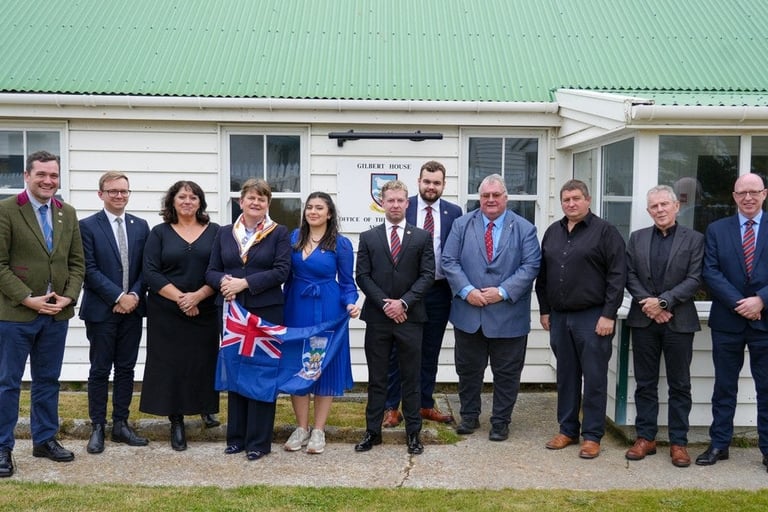

Friends of the British Overseas Territories representatives with Members of the Falkland Islands Legislative Assembly pre-election (February 2025)
The 2025 General Election, held on 11th December, was not remarkable because it was flawed or chaotic, but because it worked exactly as democracy should. Yet the outcome itself was striking. A large proportion of incumbents lost their seats, and produced one of the most significant changes in the composition of the Legislative Assembly of the Falkland Islands in recent memory. The outgoing incumbents were, and still are, highly regarded locally with impressive records. However, in a political system so tight-knit, it represented as sharp and unmistakable signal from the electorate - and the change was not incremental, but unusually decisive.
Why? The answer lies in a collection of pressures that had been building over time.
First amongst these pressures was concern about public finances. For much of the past decade, strong revenues and healthy reserves ave governments room to invest and expand. By 2025, many voters had begun to question the direction of travel as recurrent expenditure had risen sharply and there was a growing sense that the line between long-term investment and routine spending had blurred. This unease was enhanced by a series of high-profile spending decisions, as the replacement port facilities, while widely accepted as strategically important, came with a price tag unprecedented in Falklands terms. At the same time, the modern, fantastic Tussac House extra-care facility became associated with cost overruns. Each project could be, and is, defended on their own merits, but together they became symbols of a broader anxiety. Further, the 2025-26 budget was delayed, with public acknowledgement that Members were not collectively satisfied with the outcome. In a largely consensus-based system where budgets are normally presented as settled and unified, visible disagreement so late in the term was politically significant.
Alongside this sat decisions with long-term strategic implications. The formal advancement of offshore oil development, particularly the long-awaited progress on the Sea Lion field, brought renewed focus on whether the Islands were institutionally prepared for a potentially transformative revenue stream. Everywhere, resource wealth alters political expectations, and voters were not merely asking whether the development should proceed, but whether the governance architecture surrounding it was sufficiently future-proofed and robust.
Telecommunications reform also became a potent electoral issue. For a period, the use of Starlink had been effectively restricted, with the regulatory barriers and the prospect of substantial licencing fees creating the perception that the government was resisting change. Many Islanders had viewed Starlink as overdue infrastructure and a practical solution to high costs and limited bandwidth that had long been an annoyance. The public drive for access had become increasingly vocal, and what might elsewhere have been a niche regulatory question turned into a wider debate on modernisation. The subsequent shift, with the government’s renegotiation of licences, allowing Starlink to officially operate, showed that telecommunications had become a litmus test of whether government was keeping pace with the expectations of its electorate.
None of these issues alone would have necessarily produced a political rupture, and the Falklands is not prone to ideological swings. But taken together, the fiscal pressure, capital expenditure of unprecedented scale, emerging oil revenues, and institutional reform, appeared to create an atmosphere in which experience was no longer the sole electoral currency. In this case, renewal became a legitimate and necessary demand.
This fascinating result was not a rejection of the system, but an endorsement of it. Incumbents were not removed amid scandal or polarisation, but through orderly ballots and accepted results. There were no dramatic protest movements, no collapse in turnouts, or no allegations or irregularity, but a quiet assertion that the people wanted change.
But this matters beyond Stanley. For years, external commentary has framed the Falklands almost exclusively through the lens of their famous sovereignty dispute. Yet what the 2025 election demonstrated is something far more consequential - political maturity. A small electorate was willing to calibrate its leadership in response to policy concerns, not external pressure from a hostile larger neighbour or influence from elsewhere. It is difficult to imagine a clearer expression of self-determination than that.
In larger democracies, change often arrives noisily - just look at any recent general election in any Western state. But in the Falklands, it arrived decisively but calmly. This distinction is particularly important, as it shows that the democratic legitimacy in the Islands’ does not rest solely on the 2013 referendum, but on the routine and repeated exercise of political choice. If anything, the election signals confidence, as a community uncertain of its future does not rotate its leadership so freely. The willingness to do so suggests that the electorate believes the institutions are strong enough to withstand change, and the positive nature of defeat taken by politicians removed from office demonstrates this.
For the United Kingdom, this should serve as a reminder. The UK Overseas Territories are not a relic of a vast constitutional history but are living polities capable of strategic debate. When Islanders assert that their future is theirs to determine, they are not making a slogan but they are describing a system that functions.
Change is indeed afoot in the Falklands. But it is change delivered by ballots, not by instability caused externally. And that is precisely what makes it significant.
Friends of the British Overseas Territories, Registered Charity No 1156763
Friends of the British Overseas Territories is an independent and politically neutral charity. We do not support or endorse any political party or candidate. Only authorised spokespersons may make statements on behalf of the charity, via the charity’s official communications channels. All views otherwise expressed by members or officers should be considered their own.
A Charitable Incorporated Organisation, Registered in England and Wales Email: enquiries@fotbot.org
You can write to us at: Friends of the British Overseas Territories, Po Box 2635, Ilford, IG1 8UA
Promoting, Supporting and Increasing Awareness of the UK Overseas Territories