Gibraltar and the Euro-Caribbean: Overseas Territories in UK/EU relations
Gibraltar has demonstrated its key place in diplomatic relations between Britain and Europe, which are becoming increasingly important in a world where Britain must increasingly partner with other middle powers instead of relying on the United States’ (assumedly) benevolent hegemony.
NEWS FROM THE OVERSEAS TERRITORIESGIBRALTARBERMUDAOPINION
As part of the Fabian Society’s quarterly review, which sketches the ideological direction of the Labour Party, the Fabian Ideas pamphlet ‘Pressing Reset: Our Future with the EU’ championed a new outlook on British policy vis-a-vis Europe and the European Union which the Government is set to adopt in the coming years.
Chris Ward MP, minister in the Cabinet Office with responsibility for the EU reset stated ‘we want a closer relationship with the EU. We want deeper integration. We want to work with, not against our EU partners’, demonstrating a clear pivot in the way Britain relates to Europe in Labour’s foreign policy. With the Government moving in a more europhilic direction, the question of where Britain’s Overseas Territories fit in this reset is becoming increasingly pertinent.
The elephant in the room is Gibraltar, Britain’s only Overseas Territory which shares a land border with the EU. Fabian Picado KC, Gibraltar’s Chief Minister was in Westminster on Monday 20th April with Stephen Doughty MP, Minister of State with responsibility for the Overseas Territories to give evidence to the Foreign Affairs Select Committee on the recent UK-EU agreement.
The recently negotiated UK-EU Agreement in Respect of Gibraltar is a landmark treaty is post Brexit UK-EU relations. Among other things, the agreement increases mobility of persons between Gibraltar and Spain, removing physical barriers between them, with Schengen area immigration rules still technically in place at the border.
The treaty is expected to take effect in July and is yet to be ratified by the UK Parliament.
Gibraltar has thus demonstrated its key place in diplomatic relations between Britain and Europe, which are becoming increasingly important in a world where Britain must increasingly partner with other middle powers instead of relying on the United States’ (assumedly) benevolent hegemony.
This agreement has shown that the UK and EU can negotiate in good faith and come to a mutually beneficial agreement even in this time of geopolitical uncertainty. Gibraltar continues to be a key part of Britain’s national strategy.
Overseas Territories in the Caribbean as well may play some role in consolidating ties between the UK and EU. The EU’s Overseas Countries and Territories Association (OCTA) recognises eleven sovereign territories of EU member states in the Caribbean. Britain’s five Caribbean territories may thus be pivotal in fostering closer ties with Europe through pushing for closer Caribbean regional integration.
There is already some room for this institutionally. In March 2026 the Government of Bermuda published a Green Paper on full membership of the regional organisation of Caribbean states and territories, CARICOM. This was followed in April by the French government granting Martinique permission to join as a full member.
Scholars have recently coined the term ‘Euro-Caribbean’ to describe the Caribbean territories of Britain, France, and the Netherlands. In supporting the Overseas Territories to move toward full membership of the regional organisation CARICOM, Britain could bolster cultural and economic ties within the ‘Euro-Caribbean’, which would add another channel to support UK/EU relations in the coming years. CARICOM could even envisage a ‘Euro-Caribbean’ forum for non-sovereign members for this express purpose.
One thing is clear; if the government wants to pursue political and economic rapprochement with Brussels, Gibraltar and the Overseas Territories more broadly will be a key part of the conversation and the formulation of British foreign policy.
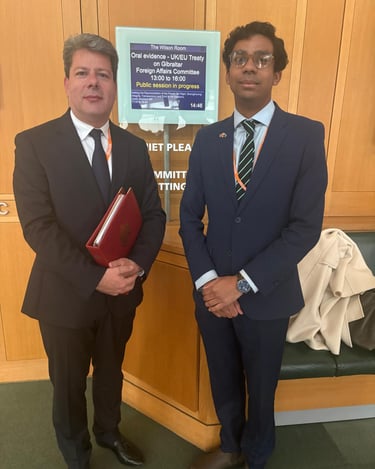
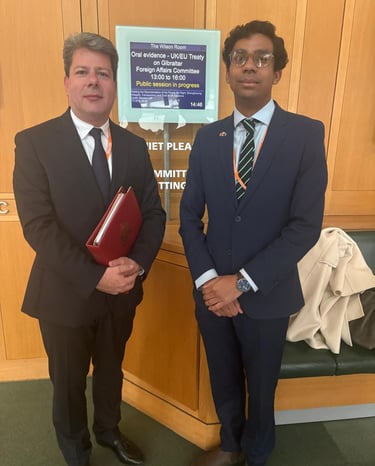
Chief Minister Hon. Fabian Picardo KC MP with FOTBOT Staff Writer Aiden Watler
Friends of the British Overseas Territories, Registered Charity No 1156763
Friends of the British Overseas Territories is an independent and politically neutral charity. We do not support or endorse any political party or candidate. Only authorised spokespersons may make statements on behalf of the charity, via the charity’s official communications channels. All views otherwise expressed by members or officers should be considered their own.
A Charitable Incorporated Organisation, Registered in England and Wales Email: enquiries@fotbot.org
You can write to us at: Friends of the British Overseas Territories, Po Box 2635, Ilford, IG1 8UA
Promoting, Supporting and Increasing Awareness of the UK Overseas Territories